Renewing Mystery

I love the intersection between the new sciences and the realm of spirit. Quantum physics often offers a scientific foundation and explanation for what we humans have considered the realm of spirit for as long as we’ve been expressing reverence.

I’ve just watched a provocative documentary by Werner Herzog called ”Encounters at the End of the World”, the end of the world being Antarctica and the rare breed of humans it attracts.

Saving the best for last, perhaps, Herzog interviews physicist Dr. Peter Gorham in the last scene. An engaging man, Gorham tries to explain the magnificence of the sub-atomic world. With helium balloons that look like long white strings when they’re still lying on the ice, the Neutrino Detection Project is trying to identify the highest energy subatomic particles known to humans. As I watch the string expand, it becomes a filmy white balloon that will eventually be a sphere 300 feet in diameter. Hard to imagine isn’t it? ( See related post about hot air balloons 9/9/2010 ) The project is based in Antarctica because once the balloon reaches the stratosphere the detector can scan thousands of square miles of ice without any electrical disturbances from habitation.

Gorham says that the project wants to be the first to identify the “ most ridiculous particle you can imagine.”  To illustrate the extent of their smallness, he says matter of factly: “ A billion, a trillion just went through my nose as we were talking and they did nothing to me – they pass through all matter all the time with no effect. They almost exist in a separate universe but we know as physicists we can measure them, make predictions. They exist. But we can’t get our hands on them.”

I apologize if that quotation isn’t exactly exact. It’s close enough to give you the idea of how miraculously small are these sub-atomic particles.

Here is the gist of what Gorham says next. Without neutrinos, the universe wouldn’t exist… no elements, no thing, can exist without them. In the earliest seconds of the big bang, neutrinos were the dominant particle. They actually determine much of the kinetics of the production of everything we know. They seem to exist in their own world and we’re trying to make contact with them.  Gorham says, “As a physicist, I understand it mathematically and intellectually but it still hits me in the gut that there is something here surrounding me, almost like a spirit or a god, that I can’t touch but I can make a measurement . . . it’s like measuring the spirit world or something . . .”

Herzog asks, “What would we see if we could see the impact of a neutrino.”

I don’t understand how Gorham can answer this question since we can’t really see these little guys, but he describes the effect as something like this: It would be like a lightning bolt ten meters long and about an inch thick and it would be the most beautiful blue light you’ve ever seen and the speed, the speed of the entire impulse would be in the range of one, one hundred billionth of a second.

I replayed that segment three times to make sure I got that speed correct.

One, one hundred billionth of a second.

Now doesn’t that give you pause? To imagine particles so small our technology still can’t show them to us, so fast that they move in billionths of a second, yet they are the foundation of our universe.

WOW.

Posted in mystery, wonder | Tagged , , | 4 Comments

Calling the Elders

Last evening our Ecstatic Wisdom Posture group met and someone mentioned it was Equinox.

Mouth hanging open, I couldn’t believe I had forgotten the return of Spring. In this temperate region where I now live, every season seems like Spring or Fall to me. Cool but not so cool that green isn’t burgeoning everywhere. And of course rain always.

I’m a bit out of whack…

I smiled because yesterday I had revised a post written at the last equinox to make it suitable for an alumni reunion publication. My 50th college reunion is coming up in June.

So, here is my call to the elders, to tell the stories of how we used to live before the digital age. It’s a call for all of us really to honor the needs of our human souls:

My nine year old granddaughter picks up a National Geographic from my coffee table. “We were alive 4 million years ago?” she asks with astonishment. The cover shows the skull of the latest anthropological find, “Ardi,” the oldest known female hominid skeleton.

Over all those millions of years, we humans slowly evolved and our lifestyles didn’t change very much. In the evolutionary eye blink since my alma mater was founded
( 1846 ), our two-legged lifestyles have changed profoundly, our priorities have shifted. The halcyon days of the ‘50’s and ‘60’s are the very same days that widened the rift between our bodies and our brains begun several generations earlier. We now suffer from a huge rent in the fabric of our human nature, the nature that has been with us for literally millions of years.

Last Fall, I volunteered to assess a stream preparatory to monitoring the return of salmon. We three women, each an elder, gathered on the driveway near our cars to decide on a date for the next stream side visit. Not one of us had a blackberry or an I-phone on which we keep our calendars. I suddenly started laughing. We are a throwback to times gone by. We keep our calendars on paper. The fish biologist, a “youngster” who may not yet be sixty, chimed in: “Hey, my wife and I keep our calendar on a dry erase board. We think that’s modern.”

I love this meeting of comrades. We grew up with black phones, ONLY black, with receivers connected to a wire connected to the body of the phone connected to the wall. AND a real person, almost always a woman, of course, said, “Hello – what number are you calling?” when we picked up the receiver and dialed “O”. A real person was always waiting on the other end of the line. Miracle!

Our Mothers and Fathers, at least mine who were a bit older than most when I was born, witnessed the invention of the airplane and the horseless carriage. My folks wrote long letters routinely – real letters on real paper, sometimes written in long hand with an ink fountain pen and sometimes typed, folded into an envelope and mailed with 1 cent stamps. They made dates and appointments, apologies to friends and professions of friendship by writing hard-copy.

30 years ago – I remember this exactly – October 15, 1981 – everything changed. Only 30 years ago, a personal computer cost $10,000 and my husband wanted to buy one.

My own children grew up without computers, digital cameras, VCR’s, DVR’s, CD’s, DVD’s, MP3’s, cell phones, I pads, I pods, whatever else exists now that didn’t 15 years ago. My kids loved rock music and went crazy over turn tables and tape decks – what a wonder!!! They did grow up with TV and Sunday family dinners in front of Walt Disney, but I didn’t see my first TV, black and white of course, until I was around 10 years old. Everyone flocked regularly to ooohhh and ahhhhhh in the neighbor’s living room during that brief time before every household on the block purchased one.

Imagine a childhood now without computers. It’s hard isn’t it?  My son tells me his sons are called “digital natives.”  We humans have been on this planet falling in love, sexing, eating, belching, singing, dancing, breathing, writing poetry, making music, dreaming, telling stories, chatting about our lives, making plans, starting wars and envisioning peace, experiencing loss, wonder, fear, success and fulfillment for millions of years.  But in only one generation we’ve become addicted to instant communication and constant visual streaming stimulation. Deadlines are NOW. Multitasking is the norm, not just the domain of harried mums. Life has speeded up beyond our capacity to respond, and we’re falling ill from stress and confusion. We’re reeling and don’t even know what’s spun us around.

The onslaught of computers and digital media have come upon us so quickly we’ve forgotten we have the right to choose how to use them.

As I walk the salmon stream, I ponder the myriad, inextricable conundrums of today and wonder how we will find our way back to a more reverent and balanced way of living. Here on this wealthy island in the Pacific Northwest, where people love nature and are devoted to sustainability, toxic waste and rain sluiced heavy metals from cars on the highway still contaminate this stream that for thousands upon thousands of years hosted spawning salmon. Foam is gathering, a sign of too much nitrogen. The fish biologist is discouraged. He’d expected to see a few young salmon this year – but there are none.

My granddaughter asks, “Gemma, why do you care about salmon?”

Her question highlights the complexity of our time when we have concluded as a culture that relating to nature is an option.  We elders can lead the way toward awakening our culture to remember a greater truth. We’re old enough to have experienced a childhood more closely aligned with human essentials – our creativity, imaginative juice and the spark of physical engagement with the world around us.

We elders living now are the last humans to bridge the old ways with the new.

May we begin telling our stories before it’s too late.


Posted in generations | Tagged , , , , , , | 6 Comments

Living in Balance

The Ides of March are upon us. I think Shakespeare has something to do with it. A time of profundity but I’ve forgotten why. How pitiful is that?

As we approach the balance of light and dark, our weather suggests that nature is in turmoil. I’m grateful to be inspired by the quickly changing moods. First rain, then hail, then sun, then rain, then thunder, then a few peeks of blue sky, then rain, torrential rain this time – and this has been going on for days.

The earth is getting soggy around here but it still seems serene in comparison to what’s happening on the other side of our tiny globe. Awe inspires me. The amazing ways of water and the mysterious deeps of our oceans reveal the real proximity of our lives on this tiny planet. Within only a few hours, those of us on the west coast of our North American continent were experiencing the consequences of earth’s upheaval in Japan. Isn’t that a marvel?

And the potential of nuclear melt down and the possibility of major radioactive fall-out promise to link us even more deeply as a global community. We are truly in this catastrophe together. We humans are waking from a long slumber of illusion. No one is immune from disaster. Some things can’t be fixed by technology and wealth. We’re waking up as a species. Many of us are changing our attitudes about what makes us happy, what gives life meaning. And that excites me.

Along with longer hours of light returning, my own artistic vision is shifting and bubbling. I took an art class from a fine woman and gifted artist last Saturday. First class I’ve taken in more than a decade I bet. Her name is Michele Zarb and you can see her work here. Her use of color is totally different from mine and I can hardly wait to see how her multi-media techniques will influence my own imagery.

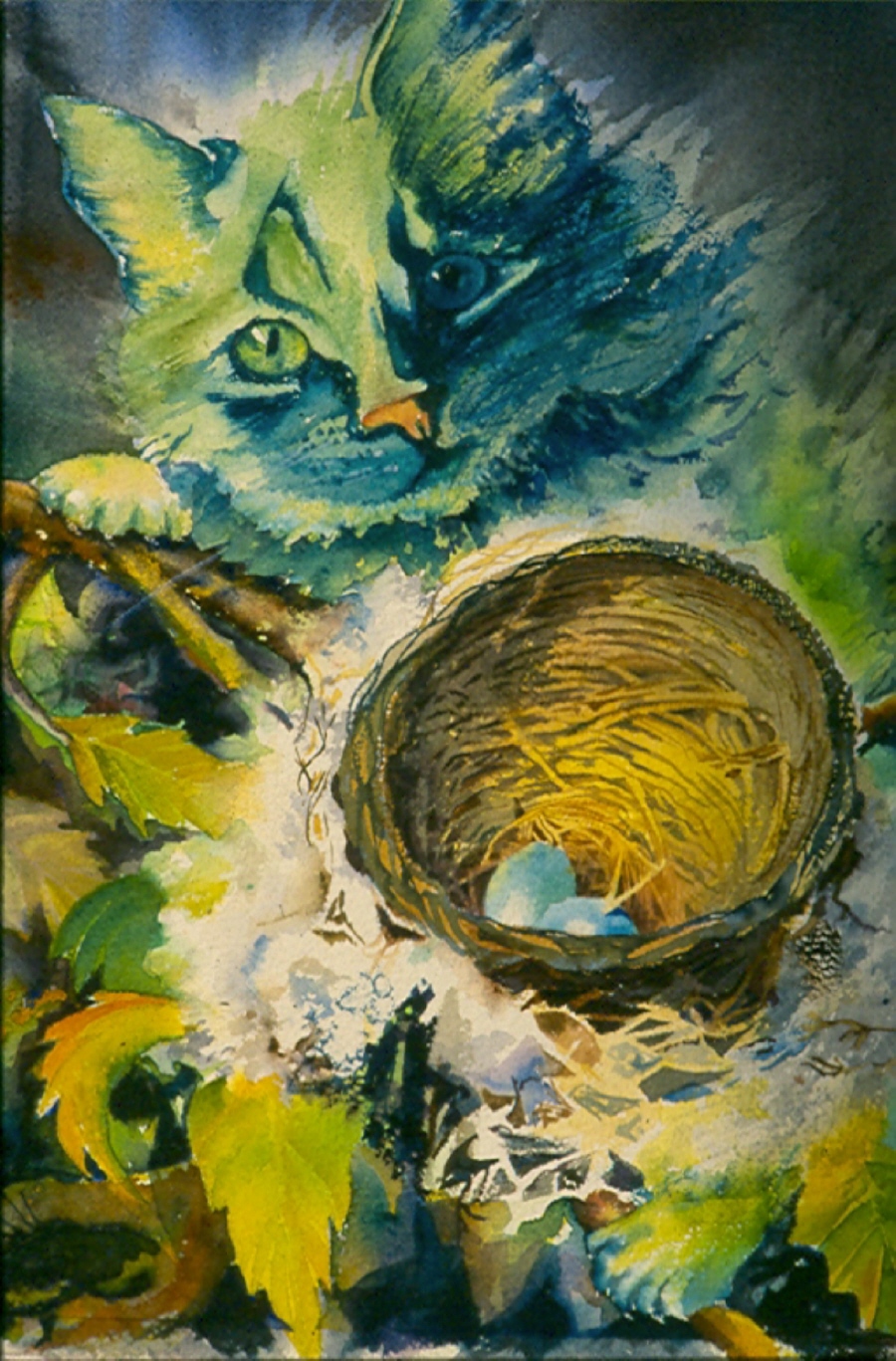
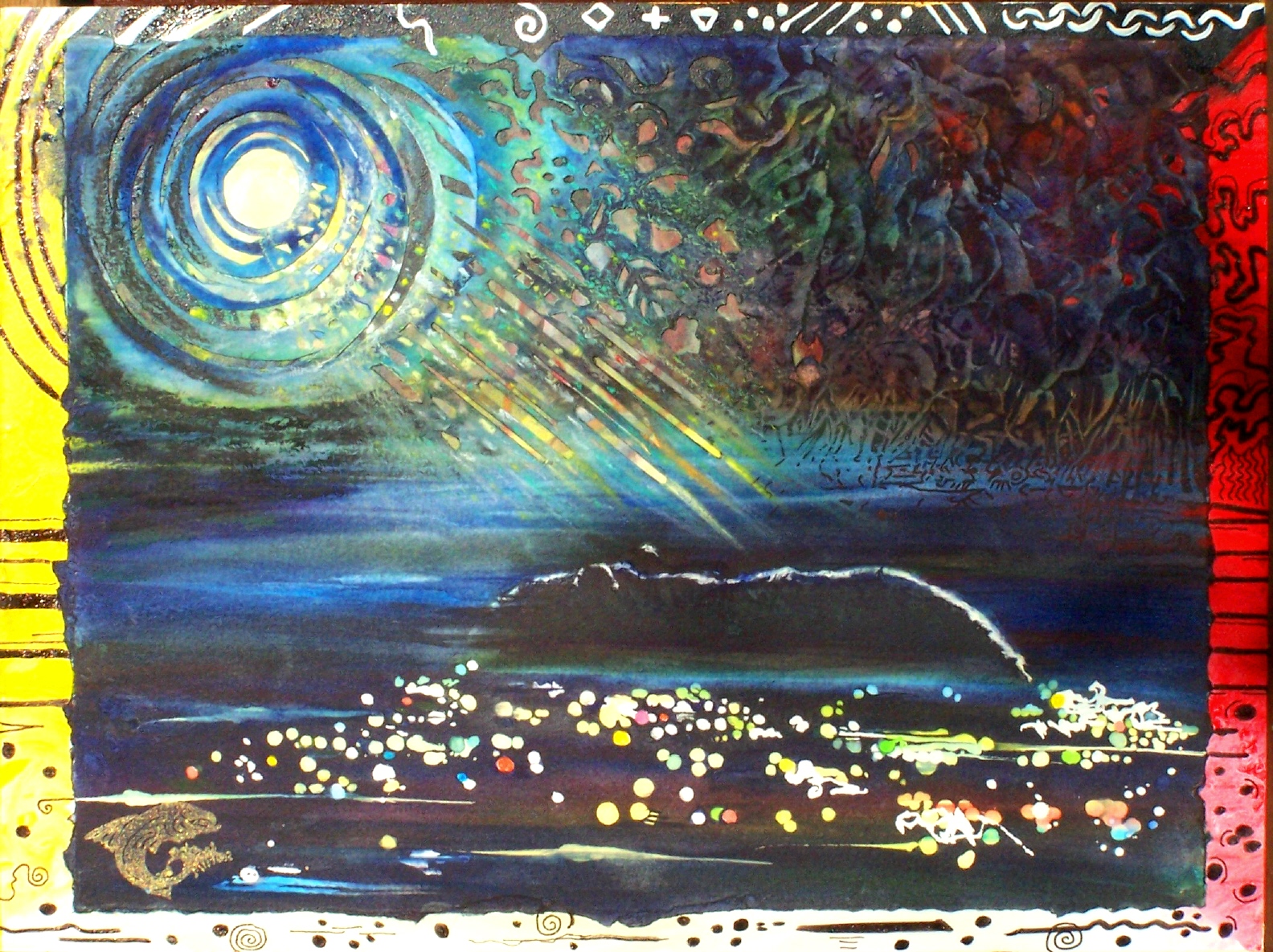
Here’s an example. Years ago when I first began painting, I painted this image called “Living in Balance.” Kind of wyrd that I bring a picture with that title to you now in this particular post at equinox. It’s about life feeding on life. I’ve always loved the nest and the eggs. . .their vulnerability and their potential gift to the cat. Here ‘t’is.

On Saturday, when it was our turn to draw a picture and experiment with these new techniques, I was drawn to a photo of a nest with eggs in it. Without thinking at all of my old nest image, I painted this new one using charcoal, acrylic, dry pigments, metallic pigments, oil pastels and colored pencils.

It was only after I got home that I remembered my earlier image and thought about the contrast between the two. I’m not yet sure what I think of the more limited color palette. I’d love your feedback!

I intend to experiment tomorrow with my typical watercolor palette but with many of Michele’s dry pigment techniques, including the black charcoal. I can hardly wait to see what happens next, both here in my small world and there in the greater one.

With love winging to all life, I bid you good-night.

Posted in mystery, vagaries | Tagged , , , , , | 2 Comments

Polyphonic Seas

So many themes concurrently stream through my thoughts, which in most cases seem located in my head though occasionally their effects affect my body.

Last night I was tired and my favorite BBC shows are pre-empted by fund raising. I decide to retire early. I wrap up in the coziness of sleeping dogs and down comforters and give this new murder mystery another try. The book comes with high praise but the first few chapters haven’t grabbed me. I start feeling sleepy by 9:30pm. Turn off the light, fall asleep and wake fifteen minutes later in a froth of cascading thoughts – worry thoughts, the kind that make me all herky-jerky and very wide awake:

What if money doesn’t start flowing?
How will I pay the rent?
How many months can my savings last without replenishment?
What if I trust too much and my art will never provide for my needs?
How will I buy food?
What if my teaching career doesn’t flourish?
What if I get sick?
What if I hurt myself again?
What if I die tonight?
What if Omi ( my dog ) gets lost on one of her yard escapes?
What if I owe taxes inspite of making no money last year?
What if Taka ( my dog ) gets stuck under the porch?

What if, what if, what if…

The “what- ifs- waterfall” catches me in the hydraulic and actually makes me laugh when I start sputtering. I sit up and turn on the light, get a shot of whiskey and a garlic cracker, pat the dogs who are safe inside the house, get back in bed and open up the book. The hero’s troubles are way worse than mine and before I know it the simple, but magnificent distraction of reading, has sluiced me away from my whirlpool of worries. ( The Cruelest Month by Canadian Louise Penny.)

I keep reading. The characters begin to take on character, the sense of community grows, the story is complicated and engaging and before I know it, I’ve nearly finished the book and it is nearly 2 a.m.

So much for an early night. HA!

But I seem none the worse for wear when I wake.

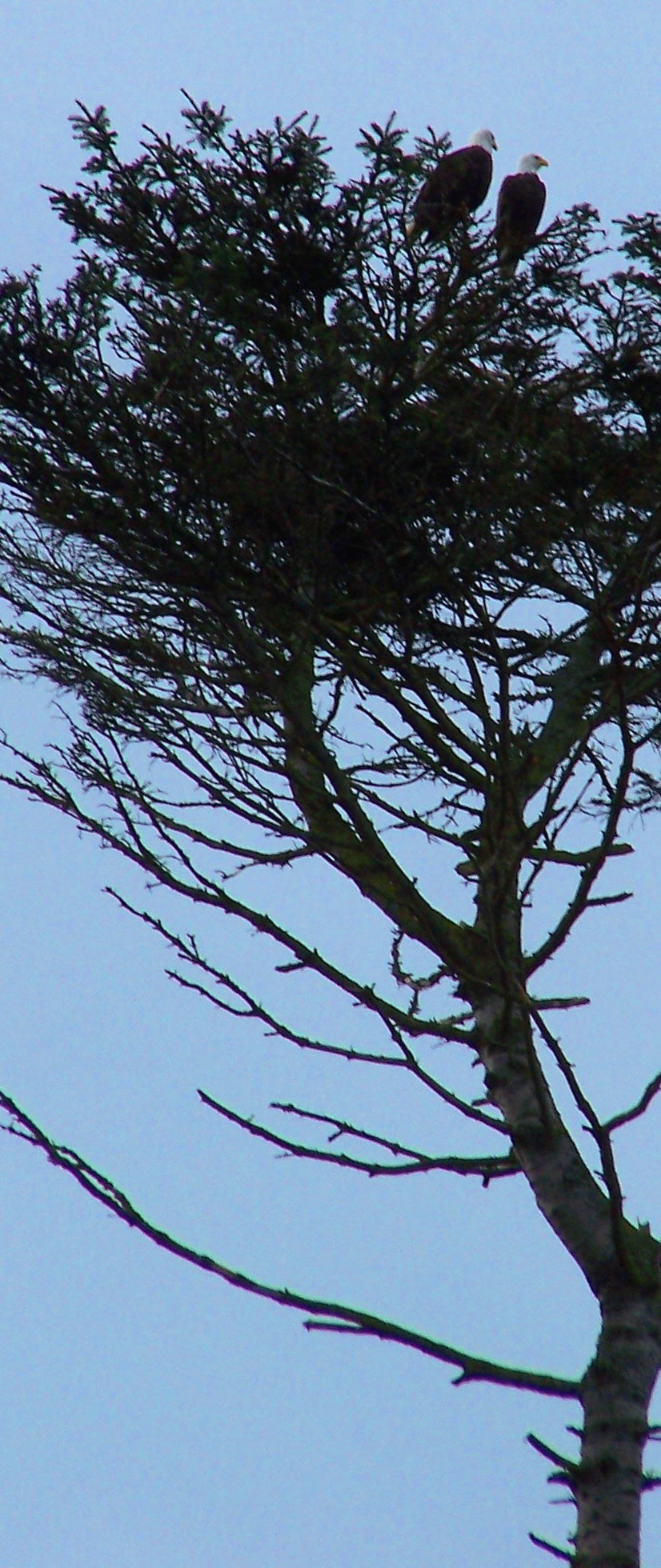
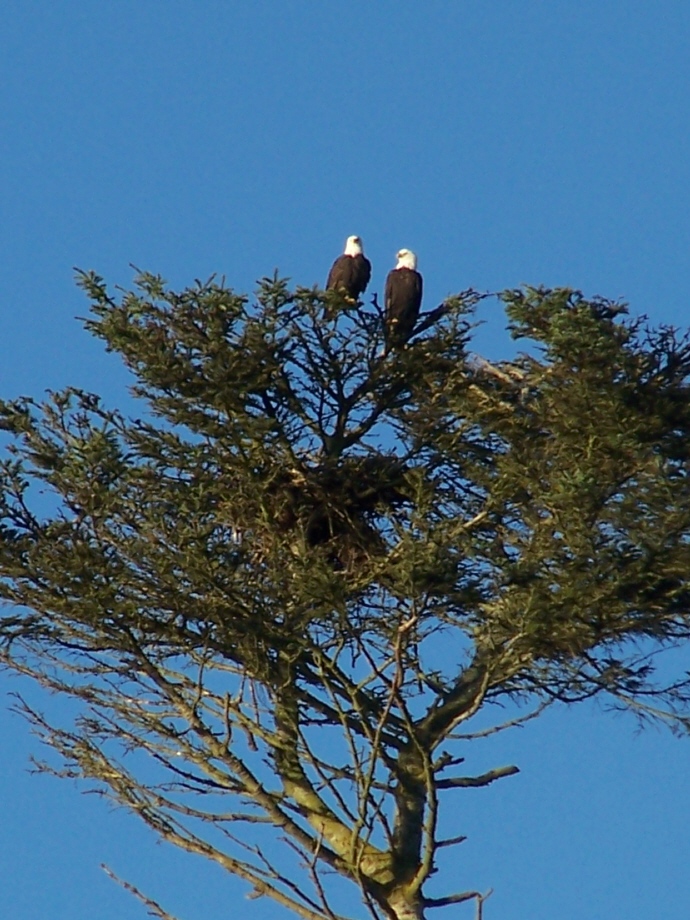
Midday, the dogs and I walk during lowish tide and get farther than usual. The waves are a bit more clattery than usual, too, and there are several times when my audible senses are pricked. Listening for eagles, I hear red-winged black birds who are beautiful harbingers of Spring here. I don’t hear the eagles today but I do see the nesting pair watching the beach from “their” tree.

The water suddenly sounds quieter as if the waves had stopped or slowed, but they’ve done neither. We have rounded a point and I wonder if that’s all it takes to make such a big audible difference.

Another time, brings a smile of harmonic delight. The waves are suddenly more powerful, rising higher and riding on top of each other in an arc to the south. I can see no explanation. But in their power they begin moving beach cobbles –  rounded pebbles about 3” across. The cobbles clatter and click and rasp and chime in an intricate cacophony which mingles rhythmically with the swoosh and shoosh and grate of the waves smashing and dragging.

Maybe the phenomena lasts for fifty-five seconds before the waves’ power dissipates, just long enough for me to identify how I’m hearing the polyphonic music of the sea plucking the beach.

I am totally comforted in this moment of being.

Posted in wonder | Tagged , , , , | 2 Comments

Gloryoski

My friend Danny Deardorff, founder of the Mythsinger Foundation wrote to tell me this: “I found this on the web for you ‘Gloriosky’ is what Little Orphan Annie cried whenever she had a sudden surprise or revelation.”

Glorioski – I spelled it incorrectly but my psyche remembered that descriptive word. Because of my sore paw, I only metaphorically jump in delight as I read Danny’s message. Thank you for validating my use of that word. I bet it’s been residing in my childhood muse-bank ever since the ‘40’s because the original Orphan Annie might have been born in the 1930’s.

I “googled” glorioski myself just now and discovered another blogger used it back in 2009. He remembered his mother using it in the mid 1940’s to mean something like this. “Now isn’t that the darndest thing?”

My new dictionary does NOT include glorioski as a word, but if I use it often enough, maybe it will become recognized as one.

I love witnessing our language change.  As a young’un I often made up words because they sounded right to me. My parents, perfect but traditional wordsmiths, made fun of me, called me Mrs. Malaprop and my former husband, who just didn’t know any better at the time, said with conviction, “We can’t make up new words. That’s not how language works.”


Well I don’t know how else language could work. Someone somewhere has to make up the first words and then all the subsequent words, one root word or root syllable or prefix or “postfix” building on another. Our rapid electronic changes have brought in a host of new words, some already included in my new unabridged Oxford dictionary, like google and blog.

Glorioski, all of that makes me happy. As world citizens, we’re scrambling out of our verbal boxes. For millenia now, words have served to “linearize” us…to make us think in single, analytical lines assuming direct cause and effect – unwittingly – or maybe not – making us think we humans are the center of the universe, thus separating us from the profundity of polyphonic thinking and polymathic being.

Polymath, according to both Oxford and American dictionaries, refers to a person of wide ranging learning or knowledge, a generalist. Once upon a time that referred to a renaissance humanist but we can no longer afford that hubris. Now it refers to someone who sees the bigger picture and “understands how we fit into the larger creation of which we are a part – equal in importance and equally sacred with all life.” (p. 69)

Polymath is a new word to me, picked up in my reading yesterday from a brand new book whose title is also a new word to me. Zugunruhe  – a German word pronounced zoo gen ROO ha . It refers to the restlessness that occurs in migrating animals before they begin to move.- Zugunruhe – The Inner Migration to Profound Environmental Change by Jason F. McLennan is the full title. On page 21 he says: “…Zugunruhe should become a new word in our lexicon to describe all of us who seek to transform the way we live; restless for a new society that reconciles its relationship with the natural world.”

That’s really what my blog is all about! Today’s wisdom needs to embrace a new truth. The planet is both too complex and too elemental, the universe too vast and too convoluted, to think that we humans – with literal thinking and solitary expertise – can wiggle our way out of not changing how we live.

We need the wisdom of knowing we do not NEED to know everything to start on our evolutionary journey to becoming eco-citizens, embodied humans and digital natives.

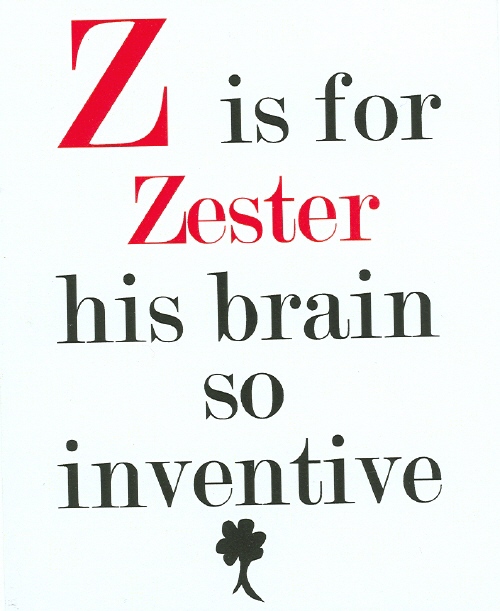
And by the way, as if you didn’t already suspect this, Zester is a new word brought into being by my son, Dave. He designed an alphabet flashcard deck, his words, my images. More on that soon.

Glorioski…


Posted in truth | Tagged , , , , , , , , | 2 Comments

Accidental Grace

Gloryoski!

Now that might not be a word, but the sound, the syllables, the shape of the letters express my dismay – a month has flown by since I last wrote.

Gloryoski!

That word bellows with my shock and amazement. Another painting exhibit got hung on the 8th but NOT by ME.

GLORYOSKI!

I spent the late evening of the 7th in an emergency room. REALLY! I severed a vein on the back of my hand while cleaning the glass for framing the “piece de resistance” of my new display. You can see it here but it doesn’t yet hang in the gallery because I don’t want to deal with the design splashed in my blood on the foam core backing.


Besides, I have only one functioning hand. Typing is slow. Washing dishes impossible. Splitting firewood beyond my wildest dreams. Can’t grip, can’t pull and tug, can’t lift. I may have injured a tendon. I may need to see a specialist. I might be in serious hand trouble and you know what? My unexpected injury, my freak accident are inconsequential compared to the brutality that happens around this tiny planet on a daily basis. Maiming each other, violating human rights, assassinating presidents, murdering innocent humans and other animals motivated by greed, fear, power – excuses for hurting each other run rampant on this globe.

I am filled with gratitude for family and friends, for safe streets to drive on late at night, for emergency rooms whose doctors are calm, informative and decent, for a clean comfortable bed and the extra pillow to cradle my wounded limb, the fire in the hearth, the healthy food that rebuilds my cells and the shot of whiskey that soothes my shock.

Accidents happen. All of us are fragile – our life’s pulse lies close to the surface of our skin wrapped innards.

Imagine the rise in security if our globe were wrapped in tenderness and reverence for our vulnerability.

Gloryoski!


Posted in mystery, wonder | Tagged , , , , , , | 6 Comments

No Detours

The new year finds me in a rich place. Both writing and painting passion-ate me! I’m surprised by how blogging motivates me to write, and of course to illustrate my words with my own artwork, painted or photographed, FINALLY manifesting my childhood dream of being an artist in the world. Umami!!!

It’s been a long detour to arrive at this focus of being.

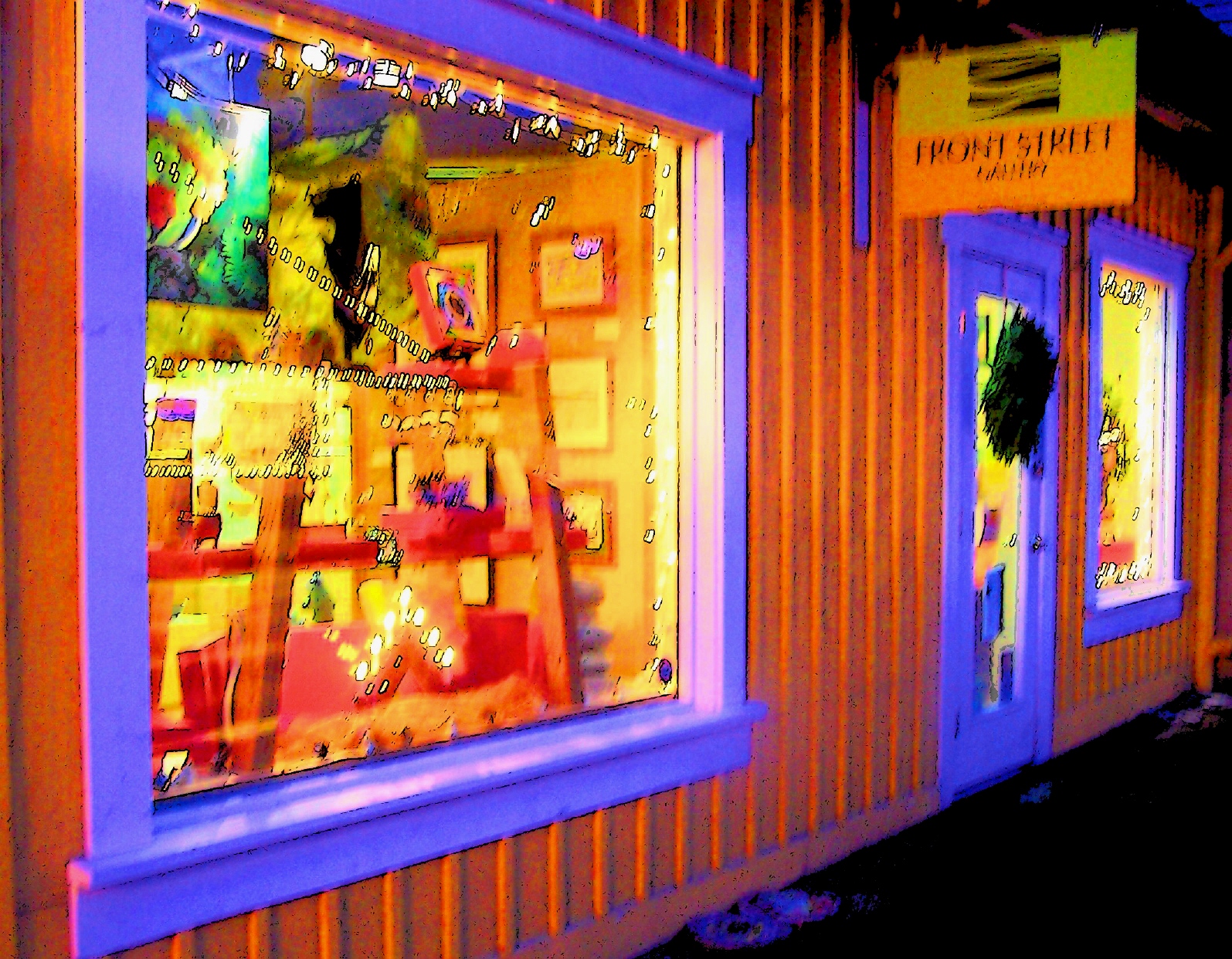
Or maybe it’s not a detour at all but the journey of this one particular soul through this experience of living in this particular creative bodymind. Each day, each minute, adds to the texture of how I respond to life. My recent invitation to join a gallery named Front Street offers a great example.

A cooperative, the artists, who number close to 25, have been together for about five years I think. But they’re new to their current location, having moved from another town in March 2010.  They seem exhilarated by their new digs and I’m ever so glad to have come on board at this time of blossoming for everyone.

To my delight – and challenge – they expected me to hang an exhibit one week after they accepted my application. Whoooops. That sent me scrambling to find my old artwork, not yet unwrapped and sorted since my move from Montana. They also encourage monthly exhibit changes and producing at least two new works a month. Occasionally they even have theme shows. February, for instance, is black and white with a touch of red. I’m off and running on that concept already, but more on that in another post.

I’ve been both focused and galvanized. Organizing my materials, kicking my granddaughters off  my art table and out of my supplies ( I gave them their own “professional” artist’s kit for Christmas!), purchasing some new boards on which to continue my watercolor experiments begun in the Fall, inventorying, re-printing business cards, note cards and prints to account for the changes in my contact info and working focus, tending to myriad details, eeeeeegad, it’s been a swirl. I almost forgot the holidays and as you have noticed, I haven’t been blogging as frequently.

So I gathered together mostly old work – images I’d forgotten about – and made it to the wall on change-over day.

I notice immediately everyone’s helpfulness. Hammers and sticky stuff for hanging labels are hand delivered, in fact the labels are actually made FOR me by someone else. Now that’s professional, isn’t it??? There is an elegant uniformity about the displays that I appreciate – even the note cards are all displayed in the same rack. When something is hung off kilter, people with kindness point it out and offer to help rearrange. People notice when lighting is poor – not just on their own work – and adjust it!

I think I’m in love!!

So in the spirit of making two new pieces a month, for January’s change-over day on the 4th I managed to finish two originals and embellished a print in fanciful ways.

BUT the most exciting decision was to repaint an old image. This has been a wonderful testimonial to my development as an artist and the fact that there are no detours in life. Back in 1997 I watercolored three images all based on the same black and white photo lent to me by a friend of a great northern bear with a newly snagged salmon in its mouth . Two sold immediately. The third lingered in my stash. The frame had been nicked over time, so when I found it a few weeks ago, I immediately knew I’d take it all apart so I could refurbish the frame. Since the painting had never sold, I concluded the image must be off. I decided to apply my thirteen years of further experience and multi-media glamor to re-paint it. So many experiences have changed me in those years that I found the image wasn’t meant to represent a kodiak, or northern grizzly bear ‘midst glaciers and artic cold, but the rainforest and the spirit bear.

I love the metamorphosis and the endless possibilities when I give myself over to destroying one thing in order to create another, when I recognize there are no mistakes and no detours. Everything depends on everything else; trials, tribulations and failings are the bedrock of fulfillment.

Ahhh yes, I like that.

Posted in wonder | Tagged , , | 11 Comments

Umami

This post is dedicated to my elder son, who lives far away on the other side of the continent. Your West Coast family misses you and your family, Dave! The image leading this post was inspired by him. He crafted an alphabet flash card deck called Aberfoible. He came up with whimsical, miraculous words for each letter and a limerick to accompany it. I drew the characters. Slavenblaven is above and that tongue captures the essense of this post and the word, umami!

*******

A word new to me has “spiffied up” my vocabulary at the end of the first year of the new decade – or is it really the end of the last year of the old decade? (I’m always a bit befuddled by markers like anniversaries and birthdays when I remember that we don’t turn six years old until we’ve finished living that sixth year.) The word is UMAMI and I just like saying it. Umami rolls easily on my tongue and conjurs deliciousness for me, which is actually what it means to the Japanese who originated it.

I discovered umami in What the Dog Saw  and Other Adventures by Malcolm Gladwell, author of two other books beloved by me: Tipping Point and Blink. ( All these books have been loaned to me by my younger son who often embellishes my life with new thought.)

The word pops up in the chapter called The Ketchup Conundrum or Mustard now comes in dozens of varieties. Why has Ketchup stayed the same?

Gladwell defines it well I suspect, especially after reading the none juicy definition of umami in my New Oxford American Dictionary. ( I hadn’t realized until I read a post by Kate Shrewsday that I had the American version – I bet the English one is quite different. )

NOAD definition: Umami is a category of taste in food {besides sweet, sour, salt, and bitter}, corresponding to the flavor of glutamates, esp. monosodium glutamate.

I took MSG ( monosodium glutamate ) out of my spice rack years ago when I discovered it might not be good for our health and that some people had allergic reactions to it, so this definition would not have captured my interest.

Page 44 of Gladwell does however. Check it out: “There are five known fundamental tastes in the human palate: salty, sweet, sour, bitter, and umami. Umami is the proteiny, full-bodied taste of chicken soup, or cured meat, or fish stock, or aged cheese, or mother’s milk, or soy sauce, or mushrooms, or seaweed, or cooked tomato. ( I begin salivating as I write those food names.) ‘Umami adds body,’ Gary Beauchamp, who heads the Monell Chemical Senses Center, in Philadelphia, says. “‘If you add it to a soup, it makes the soup seem like it’s thicker – it gives it sensory heft. It turns a soup from salt water into a food.’”. . .Salt and sugar and umami are primal signals about the food we are eating – about how dense it is in calories, for example, or, in the case of umami, about the presence of proteins and amino acids.”

“Sensory heft” grabs me and I find myself thinking about the happy heft of Christmas Eve at my daughter’s house in West Seattle. NOT ONLY is the family in smiling moods and loquacious modes  – imagine the goodness when both the teen and the almost teen are in love with their new schools, the toddlers have had naps, the elementary school girls have opened some presents already and there are more to come, the grown ups have most of the prep work done, the mother-in-laws enjoy each other’s company, the dogs are both friendly and don’t bark, the cats disappear quickly, and during the gift exchange everyone gets something he/she REALLY wants – BUT ALSO the food is dense with both calories and protein.

My daughter and I were given a secret recipe for roasting rib roast from a ‘seasoned’ butcher back in Montana – fool proof…we’ve never varied from the method since. This time her pepper mill broke while grinding above the meat and she decided to let all those little black orbs stay right where they fell. Ahhhhh yes, that along with the spontaneous forethought of my daughter-in-law to make homemade horseradish cream…oh my goodness…the look of umami on my son’s face as he purposely layered a triangle of beef with grease-browned-congealed-peppercorns with a slap of horseradish cream still has me smiling. The mashed potatoes laden with butter and rosemary – oh my, the fresh spinach salad riddled with pine nuts and tiny bits of sweet onion – oh my – and I haven’t even mentioned dessert. I must tell you, though, that my granddaughter who is just ten days into her seventh year made better butter cream frosting than I. I know that to be true because I had to make another batch when she wasn’t available to help. I curdled it!

For me, that delicious word umami relates to more than taste buds and the food we put in our mouths. Christmas Eve felt special because of the nourishment of conviviality, thoughtfulness, and delight as well as sharing wonderful food.

Don’t you think umami is a concept that could be applied to every situation? Does a conversation have enough bite to make it interesting? Does a chore have enough spice to make it worth doing? Does work have enough savory-ness to make it play? Is play dense enough to make it engaging work?  Does an encounter with another have enough nourishment to make it food for the soul? Does a mistake lead us in another direction that may actually be more satisfying?

Umami describes how I want to live my life, the full bodied taste of living life engaged with what’s happening.

I’d love to hear how you apply umami, deliciousness, to your lives.

Maybe I’ll make a bumper sticker!

Posted in generations, wonder | Tagged , , , , , , | 6 Comments

In the Deeps

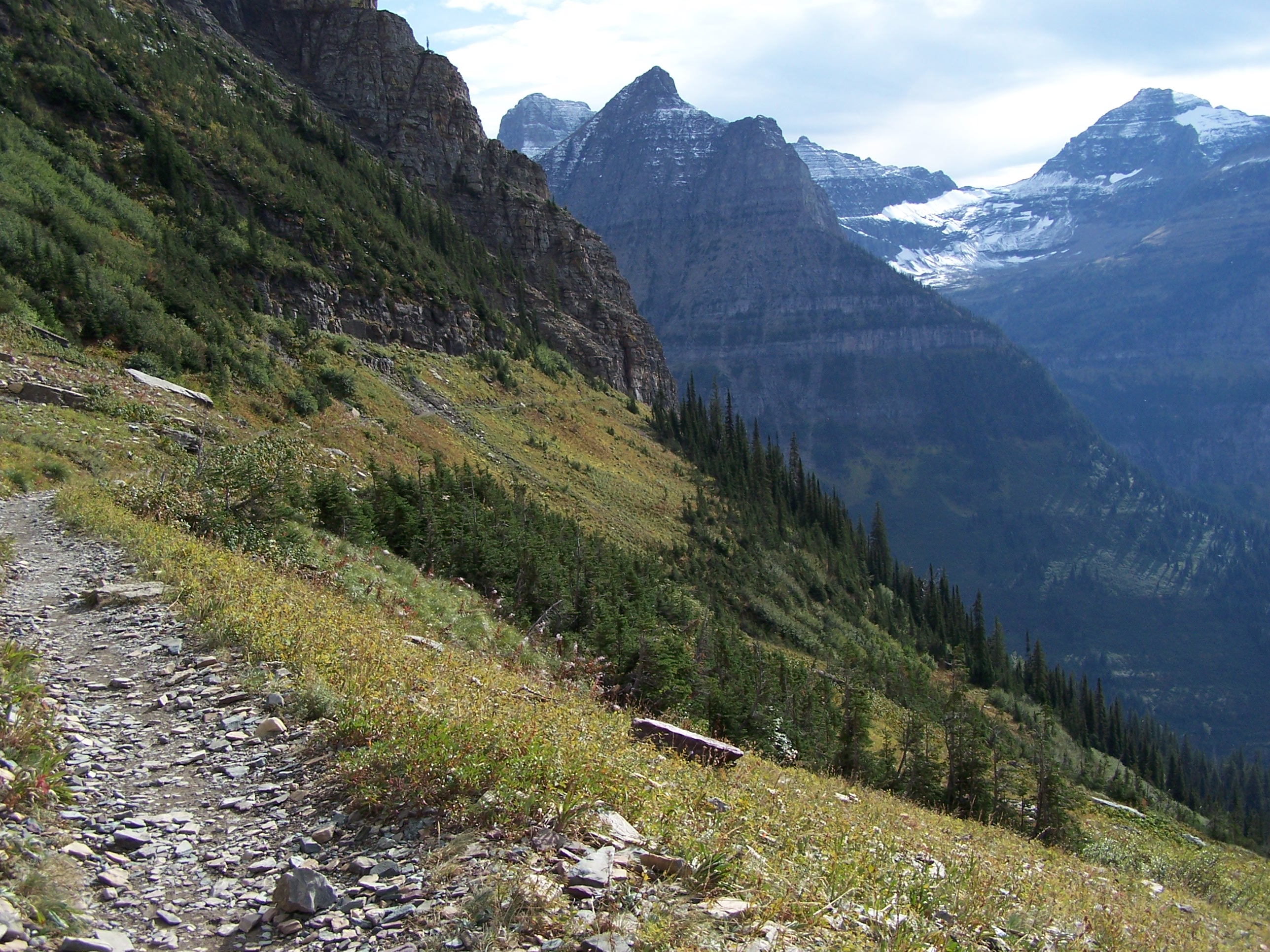
A little more than a year ago, I moved from the dry, wild mountains and plains of Montana to the watery world of the Pacific Northwest.

I’m still astounded by the differences.  While the mountains draw me up, the waters pull me down. And what an intriguing world there is in those dark and mysterious depths.

A few days ago, I met an underwater videographer named John Williams at our local Green Drinks event. By the way, Green Drinks is a great social event for people who love life on this planet. International in scope with regular events in more than 770 places, Green Drinks here happens once a month. I play a minor role in organizing the event and have met fascinating people because of attending them. John Williams is one of them.  As we chatted, he mentioned how flat the land world seemed to him after so many years spent in the depths of water. I instantly sensed what he meant. If I think of landscape as the skin of the earth, paper thin and bare before the light, then oceans are the unfathomable depths where life forms teem in the planet’s dark, like the limitless unknowns of our unconscious nature. This observation rivets me, gives me a whole new appreciation of all watery worlds.

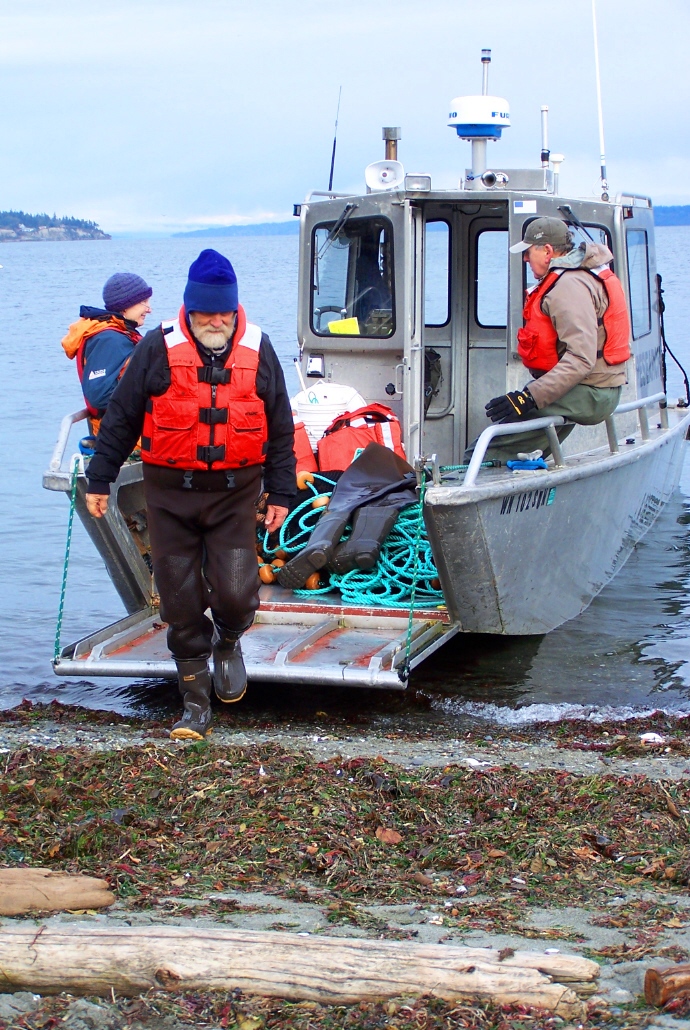
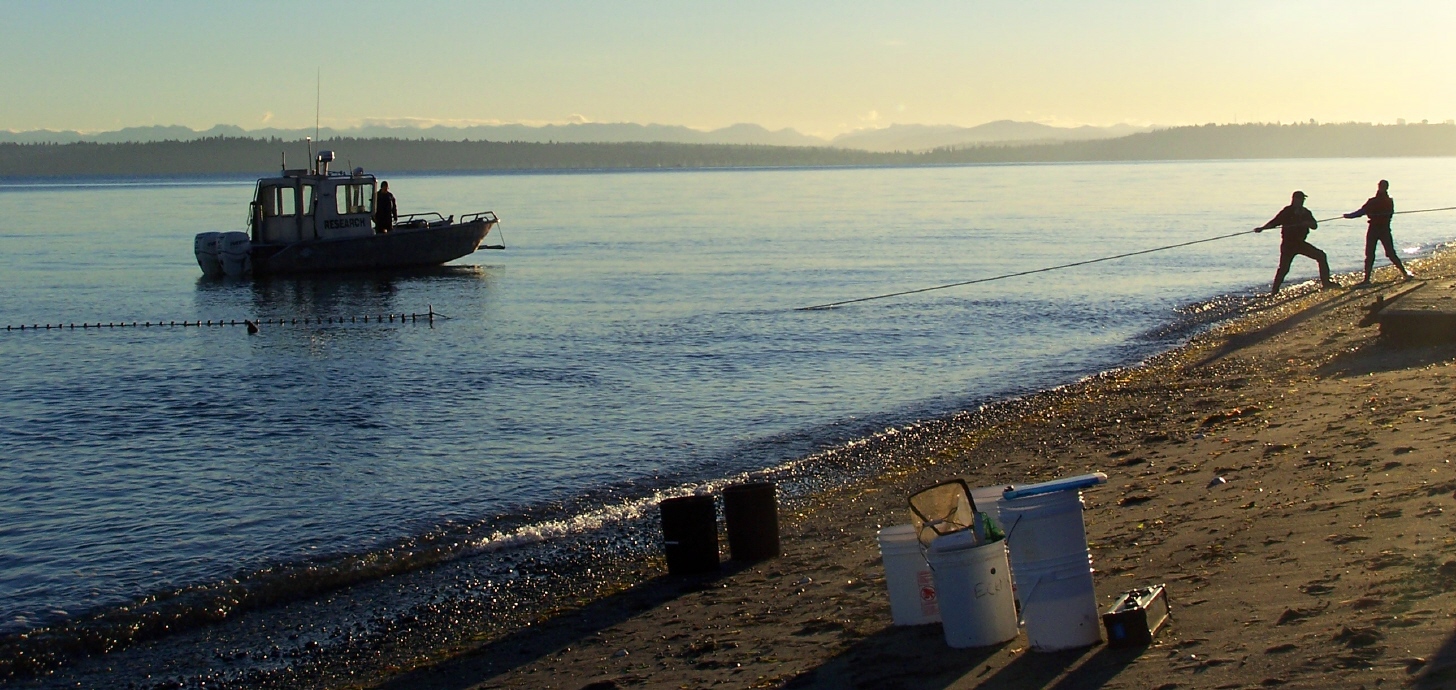
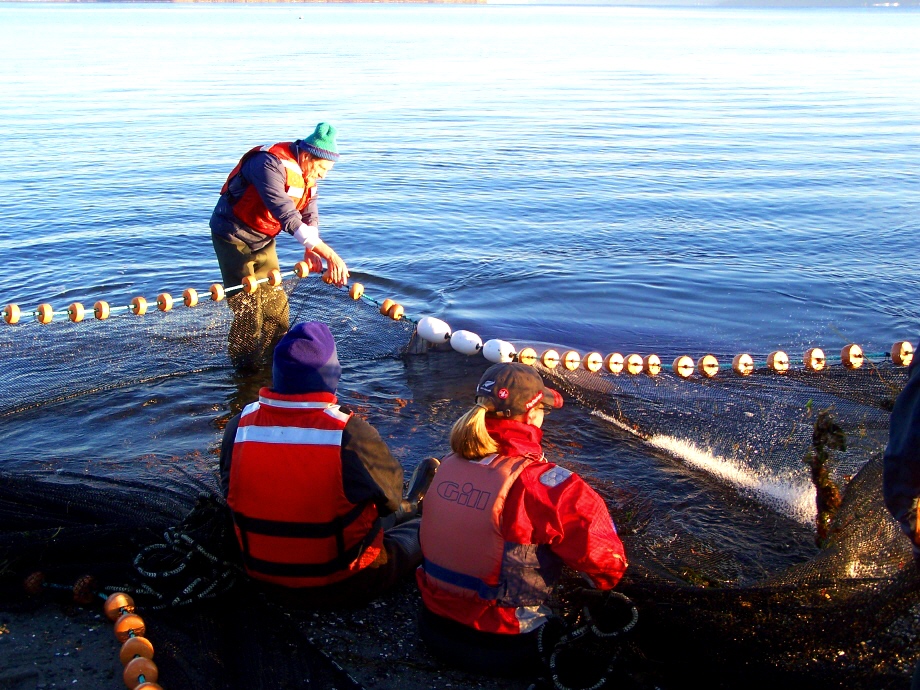
So it’s not surprising that beach seining has me in its tentacles. What is that? Beach seining is the act of floating a long net in the water near shore, pulling it tight into a circle and gathering up what has been trapped in the center mesh.

We start early – 8:30 a.m. Today is cloudless, perhaps the calm before the storm expected to move in tonight and tomorrow.

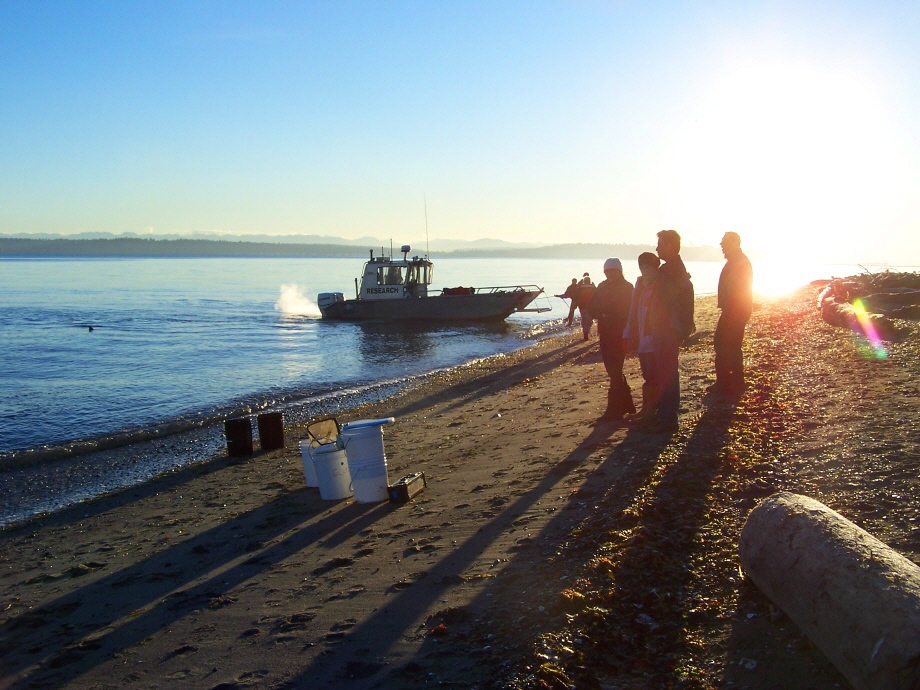
The boat is crude and functional – dented metal, tiny cockpit, buckets and tubs for seats, and a flap door that rises to close with ropes and pulleys and drops down to let us hop onto the beach.  Here’s fish biologist photo Paul Dorn on the first day I went, which as you can see was heavily overcast.

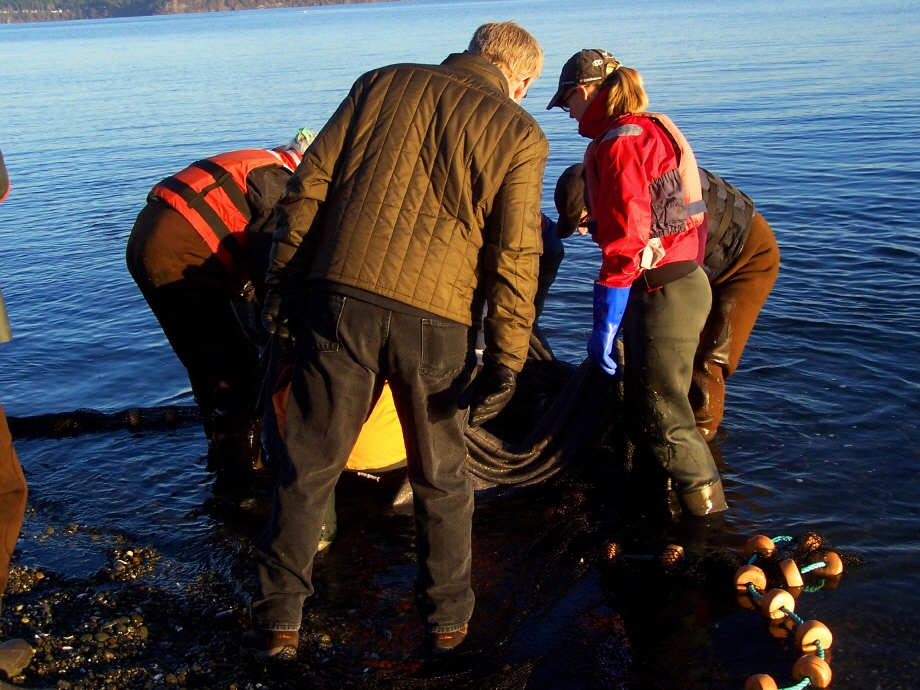
Run by the Suquamish tribe’s fish biologists, volunteers do much of the grunt work of hauling in the net and tabulating the catch.

The first thirty of each species is counted and measured, then released. All fish of each species are counted. Everyone crowds around and peers intently into the folds of mesh…the living creatures are often only two inches long and match in color and value the sea weed, plant debris, grasses, and yard waste. It takes all our eyes to spot everything.

Working with bare hands, slimyness, sandpaperyness and wiggliness require lack of squeamishness. I’ll get better with practice!

I’ve been seining twice now and expect to continue in the new year. It impacts me greatly. What astonishes me already is the variety of fish I’ve seen and the vast differences in absolutely everything each time I’ve gone.

The first time as we were laying out the first seining, three porpoises swam by. The haul of fish was gigantic. We surmised that the fish had run into the net as they fled from the porpoises. We counted 1052 snout nosed tube fish for instance…a relative of the seahorse … that first day. We counted one snout nose today. In fact, we counted only five other fish today. A Starry Flounder, one Shrimp, a Sculpin, a Steghorn Sculpin and a Striped Perch. I may have grossly misnamed these fish, but you get the idea.

Amazed by discovering 20 varieties of garlic last summer, now I’m shocked by discovering 25 varieties of fish right offshore. And some of them are wyrd! Creatures of an imagination run wild are real and I’ve held them in my hand! I marvel, for instance, over the marble sized jelly fish that are completely clear but for a thin dark line of gut in the very center, a dark line as if drawn by a mechanical pencil with size .5mm lead. In the bottom of the lavender mesh of the net, these jelly fish masquerade as bubbles.

Masses of sea birds were all about today, huge conventions of scoters and conferences of mergansers. Saw a river otter holding a big fish in its mouth, running for safety as our boat approached its beach and “cowboy sea lions” puffing up their chests as if to say, “Don’t mess with me. This is MY navigation buoy I’m hanging onto as it bucks the waves.” And then there were these two kibbitzing about our every move.

My new habitat grows on me.

Posted in gaialogue, mystery | Tagged , , , , , , | 3 Comments

Day Blind

In five more days, not only will it be winter Solstice but it will also be a year since I started this blog. Not many of you read it last December, and because darkness still calls me with its power, I thought I’d pick up on last year’s theme and make it new.

Winter Solstice calls for celebration – the light is returning, the light is returning. Each day soon will bring more minutes, then several more hours of daylight. Most humans in the northern hemisphere are jubilant, as if the sun’s return is their only source of happiness.

I wish winter Solstice were also a reveling in the glory of the longest night, as summer Solstice revels in the longest day. I don’t think anyone celebrates the returning of the dark in June. Why not?

I grieve the loss of dark, maybe because we never celebrate its return. I love night’s beauty. .. the magnificence of day blind stars, the aurora borealis launching audible awe from my throat, moon sprinkling diamonds on snow, the breath of the forest slowing as trees sleep. . .

I am more invisible in the dark feeling freer, wilder – even dare I say it, safer – no flashlight reveals my whereabouts, no fire reveals my face to the other.

My creative juice quickens in the winter. I love the inward turn of focus – possible only for those of us lucky enough to be able to adjust our frenetic schedules to account for seasonal changes. Like hot house plants, we northern urban two-leggeds live like summer all year long, forced by indoor heat and artificial light to keep producing. No wonder we have a new disease called SAD ( Seasonal Affective Disorder ). I doubt we’d feel so sad if we considered it normal to slow down in winter. With weekly regularity, perhaps, we might curl up under a blanket and sleep longer, respond creatively to the dreaming night before, cuddle together near the living room fire and tell stories, sing songs with friends and families, share food and hot drinks.

We forget that for most of human history, we were used to the dark. As Bill Bryson writes in his recent opus, At Home – a Short History of Private Life, “We forget just how painfully. . .”

Pardon me a moment while I turn on the light above my desk so I can see Bryson’s words more easily ( Note that it is 4:17 pm and already the day is fast leaving.)

. . .”dim the world was before electricity. A candle – a good candle-provides a hundredth of the illumination of a single 100-watt lightbulb. Open your refrigerator door and you summon forth more light than the total amount enjoyed by most households in the eighteenth century. The world at night for much of history was a very dark place indeed.”

Apparently, though, our eyes were accustomed to such dim lighting. Bryson shares a drawing by John Harden ( p112. ) of four family members sitting “companionably at a table sewing and reading by the light of a single candle, and there was no sense of hardship or deprivation…The fact is that people put up with dim evenings because they knew no other kind,” though they didn’t go to bed when the sun set as many of us suppose. People in the 17 and 1800’s were night owls, often eating dinner after 10 pm, dancing and conversing long after midnight.

Our modern eyes may not be as capable of seeing in the dark as they once were. I learned from an astronomer this past summer, that it takes twenty minutes or more for our eyes to adjust to nighttime vision. A simple flashlight beam can ruin it. Our eyes take another twenty minutes to re-adjust after being blinded by the light. So, the stars seem to get brighter, the longer we’re outside in the dark.

And we lose much more than night vision from light pollution. I met an educated business man from a big city on the east coast who’d never even heard of the Big Dipper, let alone seen it. I can’t imagine how it would effect my psyche to have no sense of the vastness of the universe above, its enormity recognizable – and unfathomable – only after dark. The astronomer mentioned above showed us a star burst 14,000 light years away. If that astonishment wasn’t enough, then he turned his telescope to a star cluster 250,000 light years away. Our naked eyes had no inkling these amazing phenomena existed. One woman commented as she turned away from the ‘scope, “I’m not religious but that was a religious experience.”

So, I’d love to see us find a better balance – loving dark and light in equal measure.

Loving the dark lights a fire in me. How about you?

Posted in generations, mystery | Tagged , , , , , , | 2 Comments