
I feel like an infant opening her eyes to the vast world beyond the arms of her parent.
Wow, there is so much to see, to touch, to learn about, to experience.
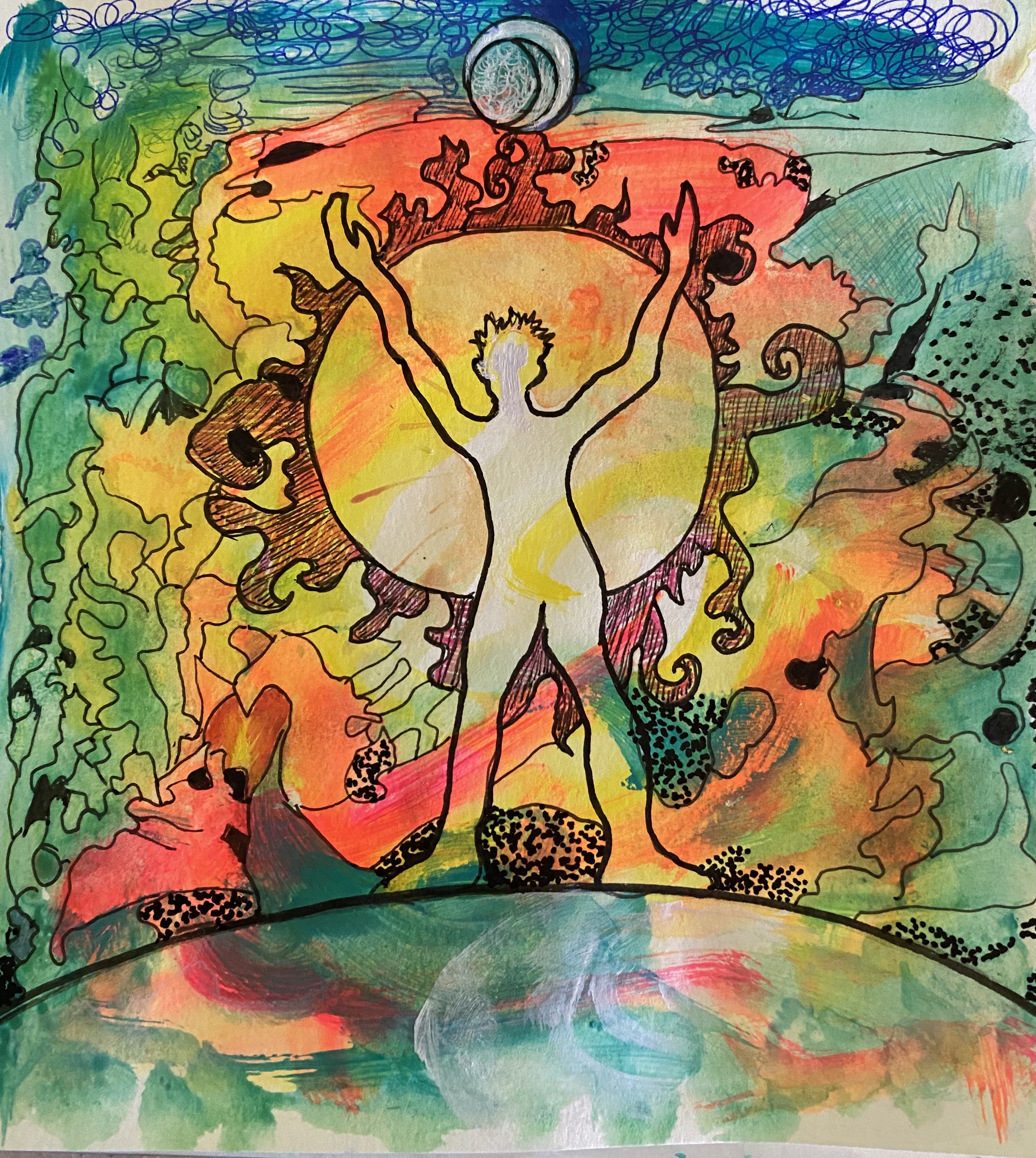
But here I am, an elder, feeling like an infant more and more often. It’s a huge world out there, and our globe is tiny, tiny, tiny spinning in the vastness of VASTNESSES. The more I learn, the more I see, the more I hang out with our local Battle Point Astronomy Association, the more I experience Earth’s vulnerability.
Holy crap…that awareness must lie just under the surface of most humans’ consciousness. Living on planet Earth is precarious! No wonder anxiety runs rampant among so many humans.
In our climate discussions we argue over whether or not humans are the cause and therefore the solution. We don’t look beyond our own motivations, the storylines we live by. A friend just forwarded a pithy article by Michael Lerner, a man I respect.
Titled: Navigating the Polycrisis – Life in Turbulent Times, I paraphrase his top ten list for what drives the polycrisis:
climate,
covid,
Ukraine war,
diminishing American world dominance,
resurgence of autocratic regimes,
explosion of AI,
global financial system chaos,
the migration crisis,
risk of nuclear accidents,
world deficits in food, water, work, safety.
Quite the list, right?? But I noticed immediately, there are more drivers to name, and they have nothing to do with our human behaviors. It’s possible those un-named drivers represent the heart ‘n’ soul of our crisis:
We continue to be self-centered, myopic, even arrogant as a species. We act as if we are in charge.
We forget that our planet is vulnerable to forces beyond human agency.
Science affirms that our wee globe has endured multiple cataclysms over the billions of years our planet has existed. According to geology and other earth sciences, we’re due for cataclysmic shifts of one kind or another. It could be the weakening of the electromagnetic forces, or the movement of our magnetic poles. It could be the sweltering heat we worry about, but I just learned that historically heat ages may flip to ice ages. We really don’t know how the slowing down of the ocean currents will affect everything. We don’t know how the drying up of fresh water impacts everything. We forget that as the sun changes, so do we.
We forget that planetary life is susceptible to galactic forces whose behavior we can’t reliably predict.
In our mad dash for immediate solutions for our warring cultures and the loss of life’s vitality, we forget to focus on our common fragility. When I was young and still in school, I learned a principle in sociology that still seems valid: when warring clans perceive a greater threat, they no longer battle each other, but ban together for communal support. It’s time for us humans to activate that instinctive behavior. Lerner calls for us to do just that. He simply calls it by another name. He calls for us to build resilient communities, “islands of coherence that could shift the whole chaotic system toward a higher level of functioning.”
As a species we need to nurture our local systems on which the cycles of living, dying, rebirthing depend. In each of our bioregions, let’s nourish planetary resilience. Let’s act locally to support life globally. What a concept! And not a new one!!! As David Korten says toward the end of his new film: For the Love of Life, “Let’s learn to BE more, not HAVE more.”


 The Wisdom of Not Knowing Everything